

1920 - 1922 - German 60 Pfennig city of Greiffenberg
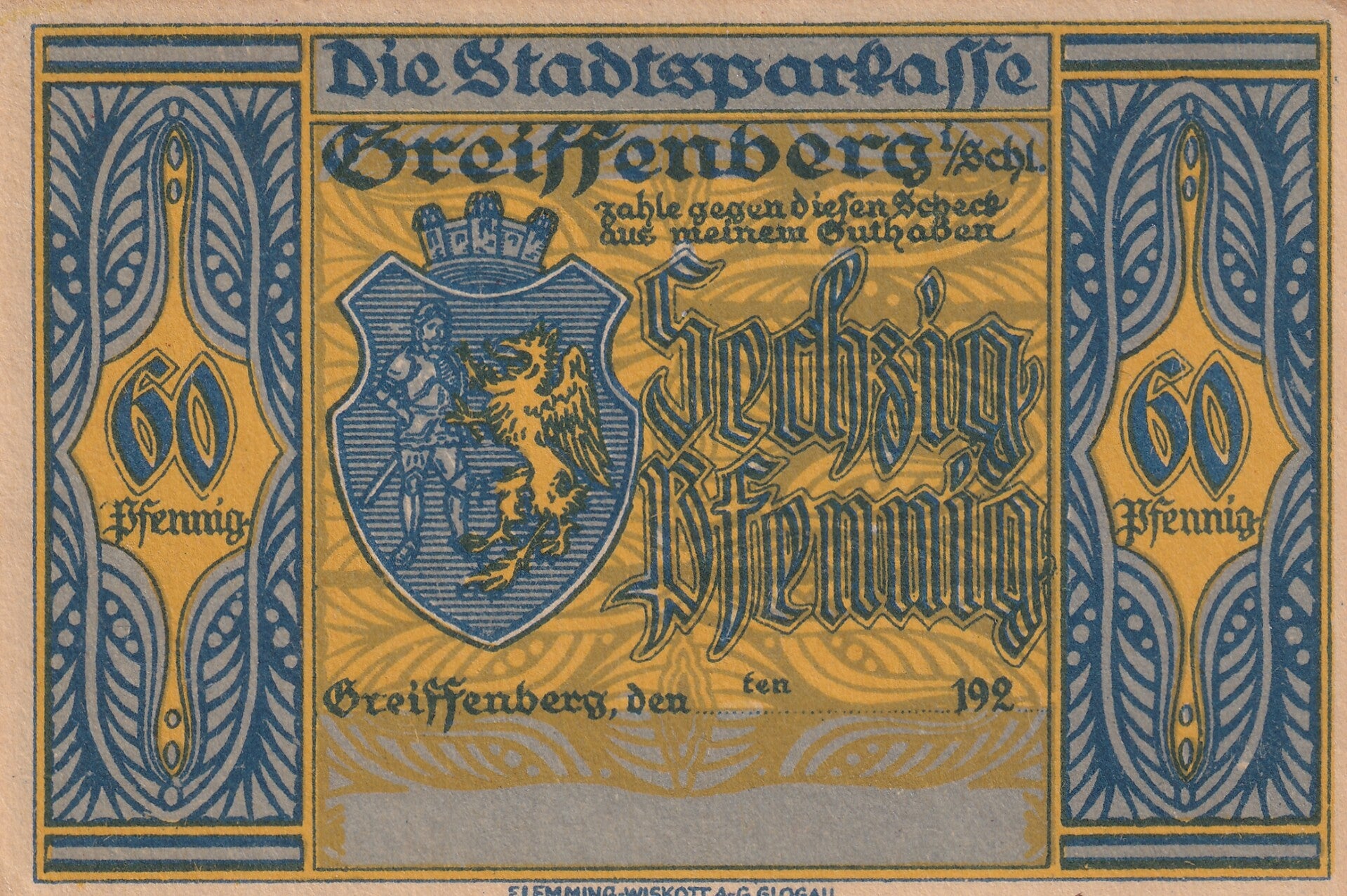

🏦 Issuer & Origin
-
Issuer: Stadtsparkasse Greiffenberg / Schlesien (City Savings Bank of Greiffenberg, Silesia)
-
Region (at the time): Province of Silesia, Germany
-
Current Location: Gryfów Śląski, Lower Silesian Voivodeship, Poland
-
Date of Issue: Circa 1921–1922
-
Denomination: 60 Pfennig
💶 Type of Currency
This is a piece of German Notgeld (emergency or “necessity” money), printed during the economic turmoil and coin shortages following World War I.
By 1921, thousands of towns, banks, and associations issued their own paper currency in denominations ranging from 10 Pfennig to several Marks.
The Stadtsparkasse Greiffenberg issued this note as part of a local bank-backed Notgeld series, used primarily for circulation within the town and surrounding markets.
🎨 Design & Symbolism
-
Front (obverse):
-
Dominant heraldic shield in the center featuring a griffin, a mythical creature symbolizing vigilance and strength — also a reference to the town’s name, Greiffenberg (“Griffin’s Mountain”).
-
To the left and right: large “60 Pfennig” denomination fields in gold panels.
-
Upper banner: “Die Stadtsparkasse Greiffenberg i/Schl.” (The City Savings Bank of Greiffenberg in Silesia).
-
Lower section includes space for the issue date (partially visible “192_”), with the location “Greiffenberg, den ___ 192_”.
-
Colors: deep blue and golden yellow, with white accents — a regal color combination emphasizing civic pride.
-
Border patterns feature interlocking Art Deco motifs, typical of the transitional period between Jugendstil (Art Nouveau) and modernist German design.
-
-
Typography:
-
The word “Sechzig Pfennig” (Sixty Pfennig) is written in elaborate Gothic script, showcasing the traditional Germanic style still common in the early Weimar Republic.
-