

1922 - 1.25 Mark - Germany - Issued by the Town of Graustee (Neumark)

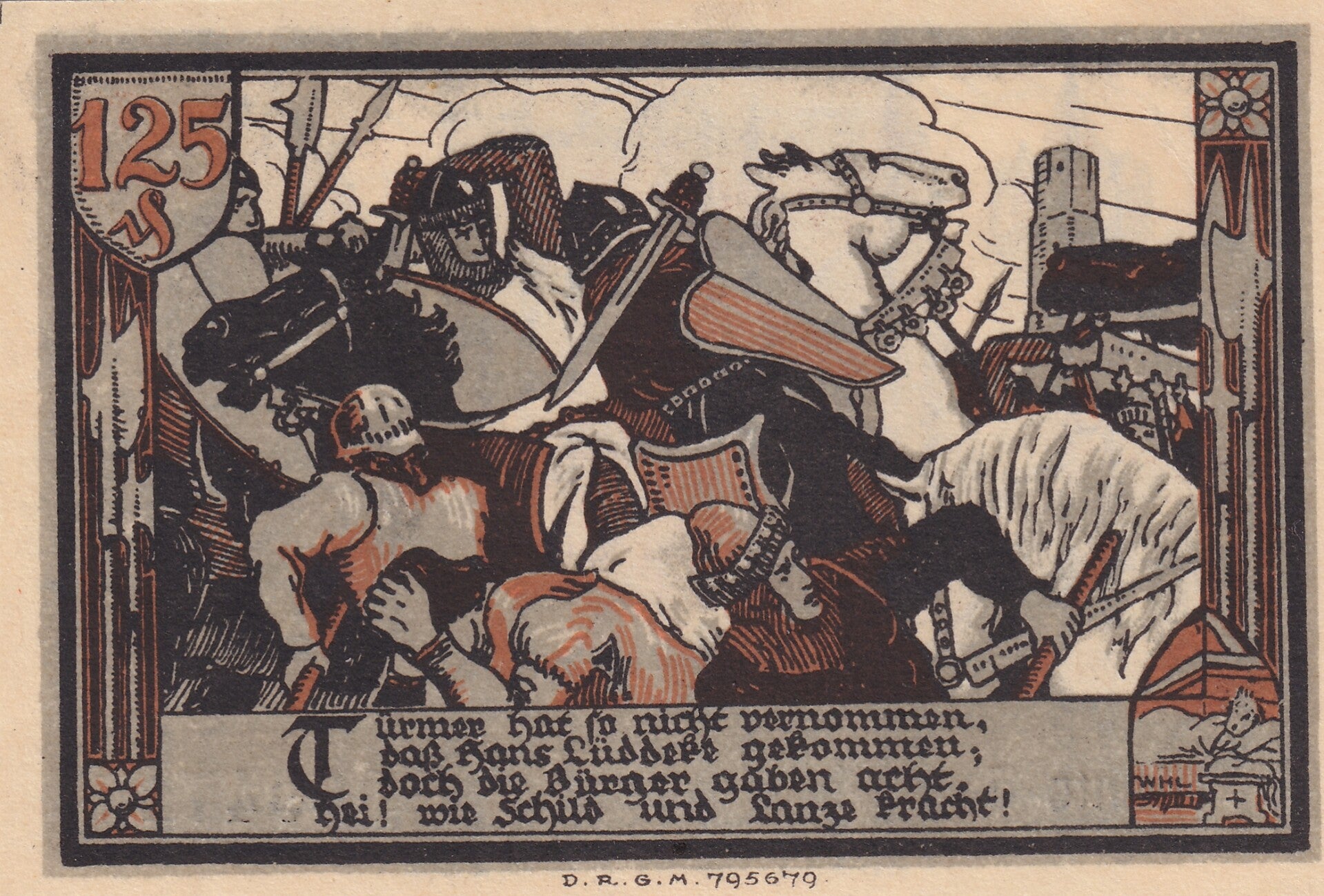
This is a 1 Mark 25 Pfennig (1.25 Mark) German Notgeld note issued by the Stadtsparkasse (City Savings Bank) of Graustee in der Neumark (modern-day Choszczno, Poland) around 1921–1922.
It’s a strikingly designed local emergency note combining Gothic architecture and early 20th-century Art Deco styling — a hallmark of Silesian and Neumark Notgeld series.
🏦 Issuer & Origin
-
Issuer: Die Stadtsparkasse Graustee i.d. Neumark (City Savings Bank of Graustee, Neumark region)
-
Region (historically): Brandenburg / Neumark Province, Germany
-
Current Location: Choszczno, West Pomeranian Voivodeship, Poland
-
Date of Issue: Circa 1921–1922
-
Denomination: 1 Mark 25 Pfennig (Ein Mark und fünfundzwanzig Pfennig)
💶 Type of Currency
This is German Notgeld (emergency money) — privately or municipally issued notes circulated during post–World War I hyperinflation.
By 1921, towns like Graustee were producing artistic series of Notgeld notes that served both as local currency and collector souvenirs, reflecting civic pride and regional history.
🎨 Design & Aesthetic Details
-
Front (obverse):
-
Central panel bears the text:
“Die Stadtsparkasse Graustee zahle gegen diesen Schein aus meinem Guthaben an den Inhaber Ein Mark und fünfundzwanzig Pfennig.”
(“The City Savings Bank of Graustee will pay the bearer one Mark and twenty-five Pfennig from my account.”) -
Left vignette: Depicts a medieval city tower and fortified street — likely part of Graustee’s historic defensive walls.
-
Right vignette: Features the Brama Wysoka (High Gate) or Gothic town gate, one of Graustee’s most recognizable architectural monuments.
-
At the bottom center: “Flemming-Wiskott A.-G. Glogau”, the printing firm responsible for many Silesian and Brandenburg Notgeld issues.
-
Serial number printed on the lower right margin.
-
Artist’s initials “WHL” appear near the right illustration.
-
-
Design Elements:
-
Uses black, red, and beige tones, a color scheme that evokes Gothic architecture and old brick masonry.
-
Lettering alternates between Fraktur (Gothic script) for traditional gravitas and Roman type for modern clarity.
-
The framing and perspective layout show influence from Art Deco and architectural engraving.
-